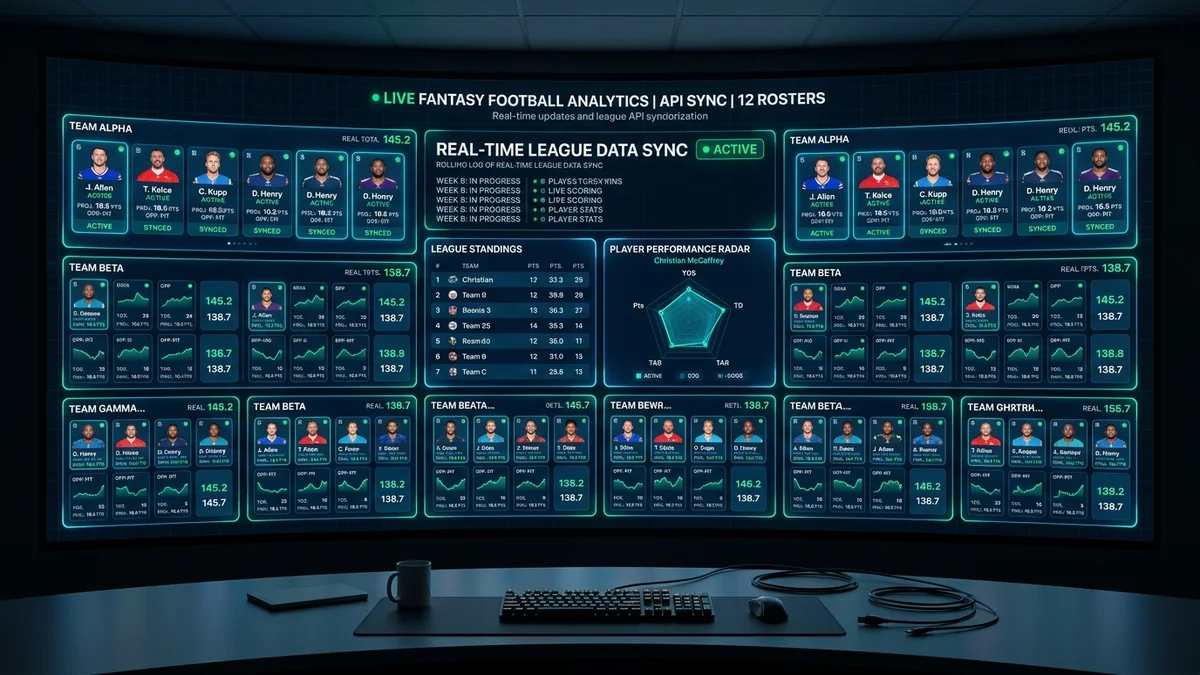
How Automated Sleeper API League Synchronization Eliminates Manual Roster Friction
Manual roster input has long been the primary point of failure for competitive fantasy football analytics. In a standard 12-team league with 15 roster spots per squad, entering 180 individual players into traditional web calculators requires upwards of twenty minutes of repetitive typing. Furthermore, manual entry is highly susceptible to human error—misspelling rookie names, confusing identical surnames (such as Brown, Johnson, or Jones), and misidentifying backup running backs.
The Sleeper Fantasy Football Team Analyzer resolves this friction through native programmatic integration with Sleeper's CORS-enabled, public read-only API. By passing a single 18-digit League ID or active username, our edge parser retrieves all twelve team rosters, weekly scoring totals, divisional alignments, and transaction logs in under 400 milliseconds. Every player ID is instantly mapped against our empirical 268-player Value Over Replacement Player (VORP) projection table, delivering institutional-grade league evaluations without requiring third-party authentication or passwords.
Instant CORS read-only JSON connection retrieves all 12 rosters without passwords.
Simulates head-to-head records against every team weekly to isolate pure schedule luck.
Dynamic replacement baseline shifts for Superflex (2QB) and TE Premium (TEP) leagues.
Sleeper Scoring Variations: Calibrating Superflex, TE Premium, and Best Ball
Sleeper has established itself as the leading platform for sophisticated fantasy configurations, featuring customizable scoring mechanics rarely found on legacy hosts like ESPN or Yahoo. A uniform analytical model that applies standard PPR assumptions to a high-stakes Sleeper league produces severely distorted advice. Our evaluation engine automatically calibrates for these key variations:
QB12 replacement threshold (~16.2 PPG) prioritizes elite wide receivers and bellcow running backs.
QB24 replacement threshold (~11.4 PPG) expands quarterback VORP by 140% across starting slots.
- Superflex (2QB) Baselines: In standard 1QB formats, replacement-level sits at approximately QB12 (averaging ~16.2 PPG). In Sleeper Superflex formats where up to 24 quarterbacks start weekly, replacement drops to QB24 (~11.4 PPG). This massive delta increases quarterback VORP by 140%, correctly prioritizing elite dual-threat passers over mid-tier wide receivers.
- Tight End Premium (TEP): Sleeper commissioners frequently award 1.5 or 2.0 points per reception for tight ends. In a 1.75 TEP league, an elite receiving tight end hauling in 85 passes gains an additional 63.75 fantasy points over the season—surpassing WR2 tier value and altering optimal starter distribution.
- Median Scoring (Two Matchups Per Week): In leagues employing Sleeper's top-half median matchup rule, schedule luck is reduced by exactly 50%. Our luck telemetry model accounts for this by tracking median win probabilities separately from head-to-head records.
Unmasking Schedule Luck: Potential Points For (Max PF) vs. Head-to-Head Record
In competitive 12-team leagues, raw win-loss records are notoriously deceptive. A fantasy manager who scores the third-most total points across 14 weeks can easily finish 6–8 and miss the playoffs if their opponents consistently register season-high scoring outputs against them. Conversely, a fortunate manager who routinely plays opponents during brutal multi-player bye weeks can coast to an undeserved 10–4 record.
Sleeper tracks Max PF (Potential Points For)—the optimal theoretical score each team would have produced had their best possible lineup been started. Our analyzer compares each squad's Actual Points against their Max PF and All-Play Expected Wins (simulating 154 weekly round-robin matchups).
Tactical Trade Playbook: Converting Positional Surplus on Sleeper
Once your Sleeper league synchronization completes, the real strategic advantage begins. By examining the Skill Core metrics across all 12 teams, you can immediately identify asymmetric trade opportunities.
For instance, if your roster registers an A+ (96) WR Room with four starting-caliber wide receivers on your bench, while a rival manager holds an A (94) RB Room but a failing D (58) WR Room, you have a mathematically optimal bilateral trade partner. Using our companion Fantasy Football Trade Analyzer, you can test 2-for-1 consolidation packages before sending trade offers directly in your Sleeper league chat.
Frequently Asked Questions
Technical and tactical guidance on Sleeper league synchronization
01 How does the 1-click Sleeper league synchronization work?
The platform connects directly to Sleeper's public read-only JSON API (https://api.sleeper.app/v1/). By providing either your 18-digit League ID or your public Sleeper username, our edge parser retrieves rosters, scoring configurations, and manager metadata in under 400ms without needing login credentials, passwords, or browser extensions.
02 Does this Sleeper analyzer support Superflex and TE Premium leagues?
Yes. The underlying VORP 4.2 valuation engine dynamically shifts replacement thresholds based on your league roster slots. In 2QB or Superflex leagues, quarterback baselines adjust from QB12 to QB24, appropriately boosting dual-threat passers. For TE Premium formats (1.5 or 2.0 PPR), elite receiving tight ends receive automated baseline calibrations.
03 How does the tool calculate Sleeper schedule luck?
It executes a full all-play schedule simulation. Each week, every team's actual score is compared against all 11 other league members (an 11-game weekly slate). Over a 14-week fantasy regular season, this yields a 154-game simulated record. Subtracting expected wins from actual win totals isolates pure schedule variance.
04 Is my Sleeper league data secure and private?
Yes. Sleeper's API is read-only and publicly accessible for all active fantasy leagues. We never store your league credentials, email addresses, or payment information. All roster valuations and simulations execute securely on your client device.